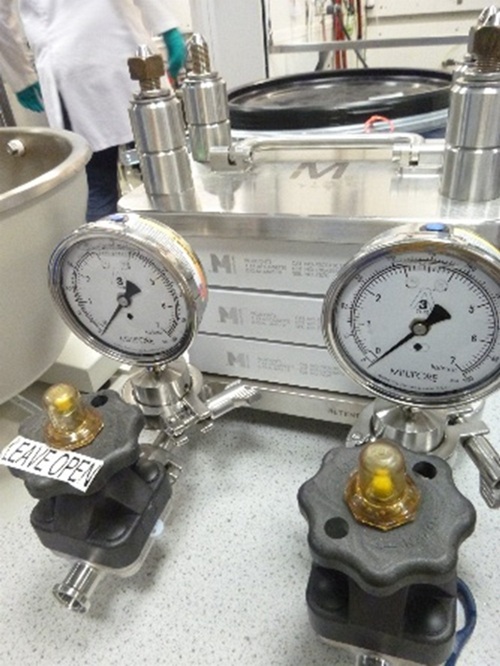
Tangential flow filtration is a core downstream unit operation at Veranova, utilized in several applications. First, TFF is applied to volume reduction and concentration. Second, for the removal of low-molecular-weight species; examples include salts, residual reagents, acids/bases, and solvent components. Third, for controlled buffer/solvent exchange via diafiltration. Processes are engineered to meet target product recovery and impurity clearance while controlling key variables including crossflow rate (shear), TMP, temperature, and run-time flux behavior across aqueous and mixed aqueous/organic systems. Veranova’s TFF platforms are designed to accommodate both development-scale demonstrations and GMP manufacturing, which helps to ensure data and performance are translated seamlessly across scales.
System Configurations and Scalability
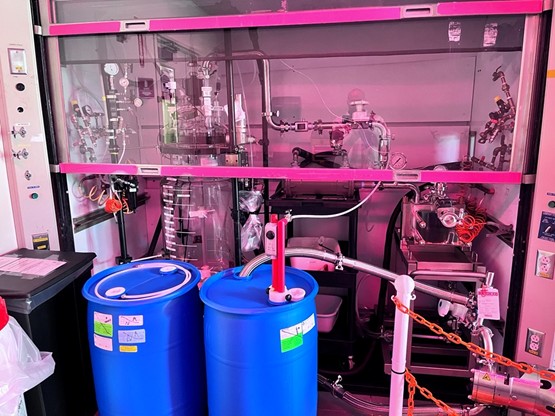
Veranova operates a broad range of TFF systems to support process development, demonstration, and commercial manufacturing:
Table 1: Veranova TFF capability
Membrane Area Range
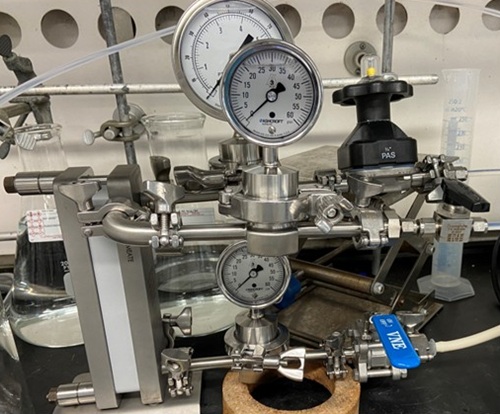
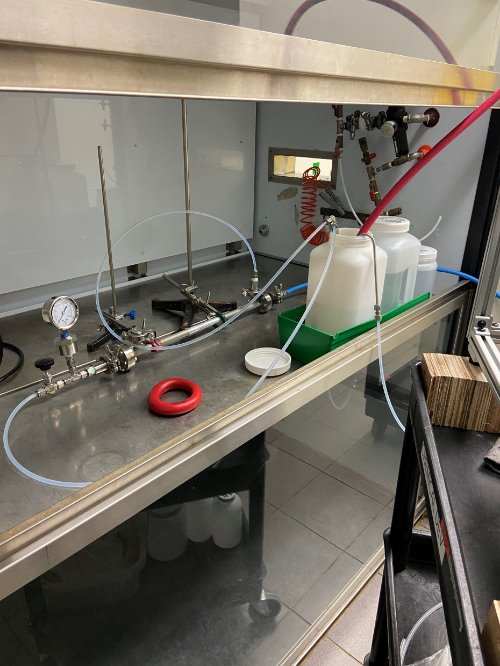
Small-scale / Development (0.011–0.11 m²): This range is used to map operating space with limited feed volumes, membrane chemistry, and Molecular Weight Cut-Off (MWCO) selection. Studies typically establish scalable setpoints for crossflow (shear) and TMP, evaluate flux sustainability and fouling propensity, and define concentration factor and diafiltration (diavolume) requirements to reach conductivity/assay or residual-spec targets while minimizing hold-up volume and material consumption.
Pilot / Demo Scale (0.55m²): Pilot systems are used to confirm scale-up/scale-out under representative hydrodynamics. The objective is to match target shear and TMP, while verifying run-time performance at relevant concentration factors. Work at this scale validates diafiltration efficiency, diavolumes to endpoint. It also characterizes mass-transfer limitations and viscosity effects. Additionally, it supports the definition of control strategies, for example, constant TMP or controlled flux operation, and temperature control. All of these steps help to ensure predictable throughput and recovery prior to GMP campaigns.
GMP Manufacturing (up to 10 m²): Manufacturing scale systems support controlled concentration and diafiltration with defined setpoints and in-process controls. This enables the delivery of consistent matrix exchange and impurity clearance. The execution places emphasis on maintaining the validated ranges for crossflow, TMP, and temperature. Additionally, normalized flux and pressure behavior are trended over run time. Finally, operational risk is minimized through qualified assemblies, documented changeovers, and compliance with handling practices aligned with the batch record requirements.
Membrane Types
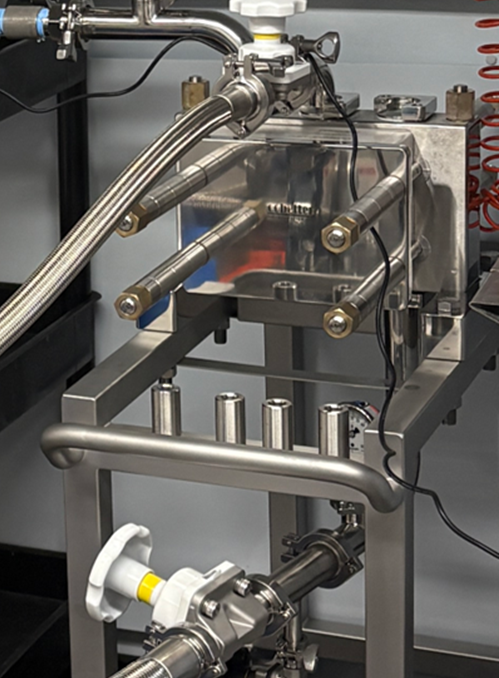
Veranova supports polymeric membrane formats, including regenerated cellulose and ceramic membranes. These membrane formats allow for the selection based on chemical compatibility, temperature constraints, target cut-off, cleanability, and expected fouling/adsorption behavior for the specific feed matrix. As summarized in Table 2, selection between polymeric/cellulose TFF cassettes and ceramic membranes is driven by the required operating window and matrix compatibility. Polymeric cassettes typically enable target performance at lower TMP with simpler hydraulics and straightforward membrane-area scaling. They can be advantageous for rapid development and routine GMP operations when solvent/cleaning compatibility is confirmed. On the other hand, Ceramic membranes generally provide broader solvent and chemical robustness and tolerate more aggressive cleaning strategies. However, they are often operated at higher crossflow and TMP. Ceramic membranes can be more sensitive to pressure drop, pulsation, and heat input. Therefore, they require tighter control of system hydraulics and temperature to maintain stable flux and reproducible separations.
| Dimension | TFF cassettes (polymeric/cellulose) | Ceramic membranes |
| Operating demand | Lower TMP / simpler hydraulics | Higher TMP and crossflow; more sensitive to pressure drop, pulsation, heat |
| Solvent robustness | Limited; must follow compatibility | Broad; typically tolerant of aggressive solvents |
| Storage & maintenance | Preservatives and storage controls required | Minimal storage constraints; easier between-run handling |
| Scale-up pathway | Area scaling is straightforward via cassette count/size | Best realized via monolith/multi-channel to increase area |
| Separation evidence in this dataset | Breakthrough observed at near-cutoff challenge | Breakthrough observed at near-cutoff challenge; possible bypass/rig effects |
Table 2: Comparison between traditional TFF Cassettes (polymeric/Cellulose) with Ceramic membranes
Hardware Platforms
Hardware includes several options for platforms. First, stainless-steel cassette holders such as Pellicon, Repligen, and Cobetter formats. Second, benchtop systems, and lastly, floor-mounted GMP skids. The platform strategy supports efficient scale transitions and changeovers as batch volumes decrease. It also helps reduce hold-up volume and product loss while preserving comparable flow-path and cassette hydrodynamics where appropriate for technology transfer.
Demonstrated Process Capabilities
- Low-Temperature and Cryogenic Operation
Veranova has demonstrated TFF operation at low and sub-ambient temperatures to support temperature-sensitive compounds and to manage viscosity- and solubility-driven performance constraints. These workflows are executed with attention to solvent compatibility, temperature control, and the impact of temperature on permeate flux, TMP requirements, and mass transfer during concentration and diafiltration. - Analytical Measurements
TFF performance is assessed against program‑specific acceptance criteria across development, demo, and GMP runs. We use in‑process and offline analytical methods appropriate to the matrix and modality to assess performance. First, size‑exclusion chromatography coupled with multi‑angle light scattering (SEC‑MALS) is used to assess product molecular weight, aggregation, and integrity across concentration and diafiltration steps. Second, liquid chromatography (LC) methods are applied to quantify product recovery and clearance of low‑molecular‑weight impurities. Third, gas chromatography (GC) is used to monitor residual organic solvents during solvent or buffer exchange. Lastly, Karl Fischer (KF) titration supports determination of water content and confirmation of final matrix composition where required. These analytical readouts are interpreted alongside run‑time monitoring of pressure, flow, temperature, and flux behavior to confirm process performance and scalability. - GMP Manufacturing Experience
Veranova has successfully executed full GMP TFF campaigns for cassette systems up to 10 m2. The execution of batch record instructions requires controlled concentration and diafiltration operations. GMP runs are managed using defined setpoints and alarms. Assembly and changeover practices are documented. Additionally, monitoring and trending key process variables, such as crossflow, TMP, temperature, and flux behavior, ensure consistent performance and product quality. - Integrated Development-to-GMP Approach
A key strength of Veranova’s TFF capability is execution with scale-relevant engineering intent. Development and demonstration runs are designed to replicate GMP-relevant hydrodynamics, establish scalable control modes, and define operating ranges that translate to manufacturing. As volumes decrease during processing, appropriately sized systems can be deployed to help reduce hold-up and improve recovery. Meanwhile, development learnings (membrane selection, fouling controls, diafiltration endpoints) directly inform GMP batch execution and technical transfer. This approach reduces technical risk, shortens timelines, and supports predictable performance during technology transfer.
Applications
Veranova’s TFF platform is applied to a range of product types and process streams. Our platform can be applied to small molecules and intermediates. It also applies to peptides and other TIDES (including oligonucleotides) that require desalting and buffer exchange. In addition, it can be utilized in bioconjugation-related streams (including ADC workflows) where removal of excess linker/drug, quench reagents, and other low-MW species is required. The platform also supports solvent exchange into aqueous or mixed aqueous/organic compositions with controlled final matrix and late-stage polishing prior to isolation, formulation, or drying.